Rolls-Royce · Technology guide
Black Badge Spectre:
technology explained
The mode buttons are only the beginning. Discover how electric performance, suspension control and digital intelligence give Black Badge Spectre its distinctive character.

At a glance
500 kWSeries II maximum power in Infinity Mode.
1,100 NmSeries II peak torque in Spirited Mode.
Beyond accelerationChassis tuning, digital coordination and personal cabin technology.
Infinity and Spirited Mode do different jobs
The current Black Badge Spectre Series II delivers 500 kW in Infinity Mode and up to 1,100 Nm in Spirited Mode. These are the manufacturer’s mode-specific maximums. They describe two different aspects of its electric performance.[1]
| System | What it changes | What the driver should understand |
|---|---|---|
| Infinity Mode | Access to the full power output and a more immediate accelerator response. | A change in the motor car’s response, selected through the Infinity control. |
| Spirited Mode | A temporary increase in torque for a burst of stationary acceleration. | A separate launch function, not a general driving setting to leave engaged. |
At the original Black Badge launch, Rolls-Royce explained that pressing the steering-wheel Infinity button changes both throttle response and the instrument presentation. Spirited Mode was developed for a concentrated burst from rest. The Series II announcement increases the headline outputs; use the handbook for the exact motor car’s activation procedure and conditions.[2]


Why distinguish power from torque? Torque is twisting force; power describes how quickly work can be done. In a motor car, gearing, weight, grip and software also shape the acceleration you feel. A large torque number does not explain the whole experience, especially the first few millimetres of accelerator travel.
A useful distinction when researching: original Black Badge Spectre figures are 485 kW and 1,075 Nm in the respective modes. Series II figures are 500 kW and 1,100 Nm. Match the specification to the actual motor car, particularly when looking at pre-owned examples.[1][2]
The chassis is part of the Black Badge character
Extra output alone would not create a more engaging Rolls-Royce. For Black Badge, engineers increased steering weight, adjusted roll stabilisation and enhanced the dampers to control body movement, including squat under acceleration. The intention was more feedback while preserving the marque’s characteristic ride.[2]

Spectre’s underlying Planar suspension explains how that comfort is achieved. On a straight road, the system can decouple the anti-roll bars so the wheels respond more independently to uneven surfaces. As a corner approaches, it recouples the system and changes damping, coordinating its response with four-wheel steering.[4]
A conventional anti-roll bar links movement across an axle to resist body roll. Releasing that link when it is unnecessary helps avoid one wheel’s disturbance rocking the cabin. Bringing it back for a bend restores support. The important technology is the transition between those jobs.
A useful drive therefore includes more than a smooth, straight road. Compare steering response through an ordinary bend and the way the body settles after an uneven surface, as well as the initial accelerator response. Those observations reveal more of the engineering than a single full-power acceleration run.
Software connects the systems behind the calm
Rolls-Royce calls Spectre’s approach Decentralised Intelligence: information is processed close to its source, rather than every decision passing through one central processor. Its engineering documentation describes direct communication between vehicle functions and continual adjustment of steering, braking, power delivery and suspension.[3]
The benefit is coordination. A change in direction should not feel like separate steering, suspension and powertrain events. The software’s job is to make the hardware respond coherently, with much of the work remaining invisible to the occupant.


Spectre’s power-assisted coach doors are another example. Rolls-Royce’s technical background describes sensors that account for slope and door forces, maintaining consistent operation on an inclined driveway. From the driver’s seat, pressing the brake pedal can close the driver’s door.[3]
It is an instructive contrast: the mode button makes performance immediately obvious, while door assistance removes a small effort each time you use the motor car. Both are expressions of technology working around the occupant.
SPIRIT makes the digital cabin personal
The SPIRIT digital architecture manages vehicle functions and connects with the Whispers app. Rolls-Royce extended Bespoke into the interface, allowing instrument colours to complement the physical specification; Black Badge introduced five expressive dial themes. Remote information includes charging and vehicle location.[2][4]

That gives personalisation a functional dimension. A calm display, a distinctive instrument theme and the information available before departure all influence how you use the motor car. When exploring a specification, compare display legibility and the controls you will reach for most often, as well as the colours.
For an existing motor car, the relevant demonstration is its own installed system and connected services. A photograph of another commission cannot establish which functions or account services are active on the example you are considering.
Series II: battery and material technology move on
Series II uses re-engineered battery-cell technology. Rolls-Royce quotes up to an 18% range improvement and up to a 14% reduction in charging times for the update. The published Black Badge Spectre Series II WLTP range is 359–390 miles, depending on specification.[1][5]
Those are comparison figures, not a promise for every journey or charging stop. Temperature, speed, load, battery condition and the charger affect the result. The meaningful change is that cell development improves usable journey capability without asking the owner to choose a different kind of Rolls-Royce.
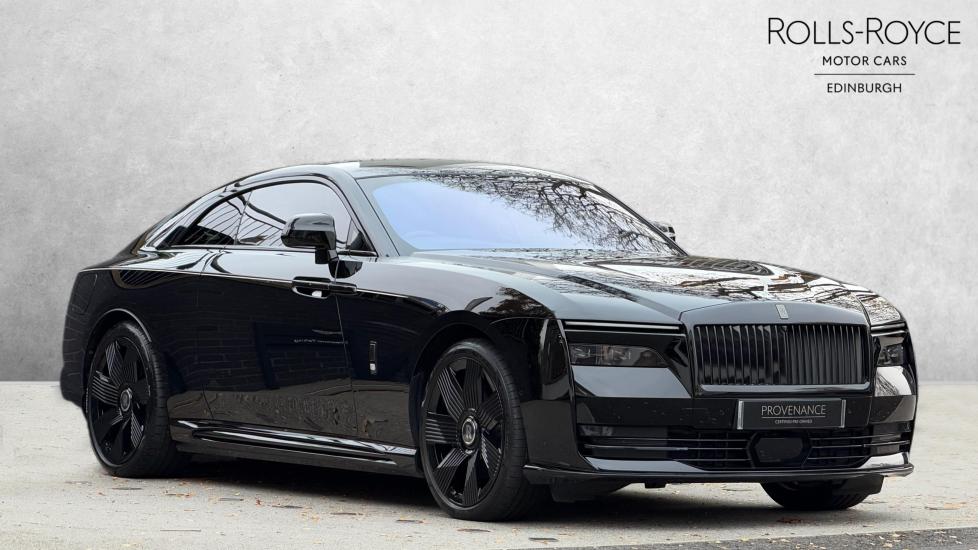
Technology also appears in the materials. The Series II cabin offering includes Duality Twill, a bamboo-derived rayon with an embroidered pattern, and precision-made finishes. Black Badge’s Iced Black treatment uses a specially developed matte clear coat on selected exterior detailing, while the grille vanes retain their polished finish.[1]


Explore the engineering with Rolls-Royce Motor Cars Edinburgh
Grange’s history began in 1956. Rolls-Royce Motor Cars Edinburgh provides a local route into a new commission, Bespoke choices and ownership support.[6]
Begin with the character you want from the motor car, then explore the engineering that creates it: accelerator response, steering weight, ride behaviour and the digital environment. The team can explain the specification, relevant modes and connected services of the particular example or proposed commission.
For the broader model choice, read Spectre or Black Badge Spectre?. For installation planning, our Spectre home-charging guide covers a different part of electric ownership.
Your technology questions answered
What is Infinity Mode on Black Badge Spectre?
It gives access to the full available power and a more immediate accelerator response. The current Series II headline is 500 kW; the original Black Badge Spectre figure was 485 kW.
Is Spirited Mode the same as Infinity Mode?
No. Spirited Mode is a temporary torque-boost function for stationary acceleration. Series II is quoted at up to 1,100 Nm in this mode, compared with the original model’s 1,075 Nm.
Is Black Badge Spectre Series II fully electric?
Yes. It uses an electric drivetrain. Its published Black Badge WLTP range is 359–390 miles, with actual range dependent on specification, conditions and use.