




ASTON MARTIN · THE REAL-WORLD BUYING GUIDE
Aston Martin DB11 V8 vs DB12
Same 4.0-litre capacity. Two different generations of grand tourer. Discover what DB12 changes beneath the bodywork, where DB11 V8 still makes a compelling case, and how UK prices and Aston Martin ownership support shape the decision.

The differences that matter
- DB11 V8: an engaging, rear-drive GT with a substantially lower entry price in the Grange examples checked.
- DB12: 680 PS, an electronically controlled rear differential and a much more contemporary cockpit.
- Choose the right baseline: original DB11 V8s have 510 PS; the 22MY update brought 535 PS. This guide compares Coupes, excluding DB11 V12, Volante and DB12 S derivatives.
The resemblance is real. So is the change.
DB11 and DB12 share the long-bonnet, rear-drive, 2+2 recipe that makes an Aston Martin DB so distinctive. The visual relationship can obscure the scale of the engineering work. This is a predecessor-versus-successor decision: how much do you value the newer car’s responses and technology, and how much of your budget would you rather retain?
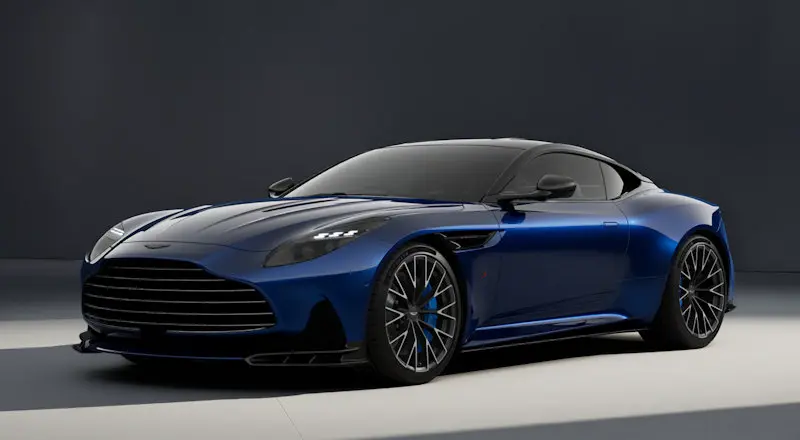
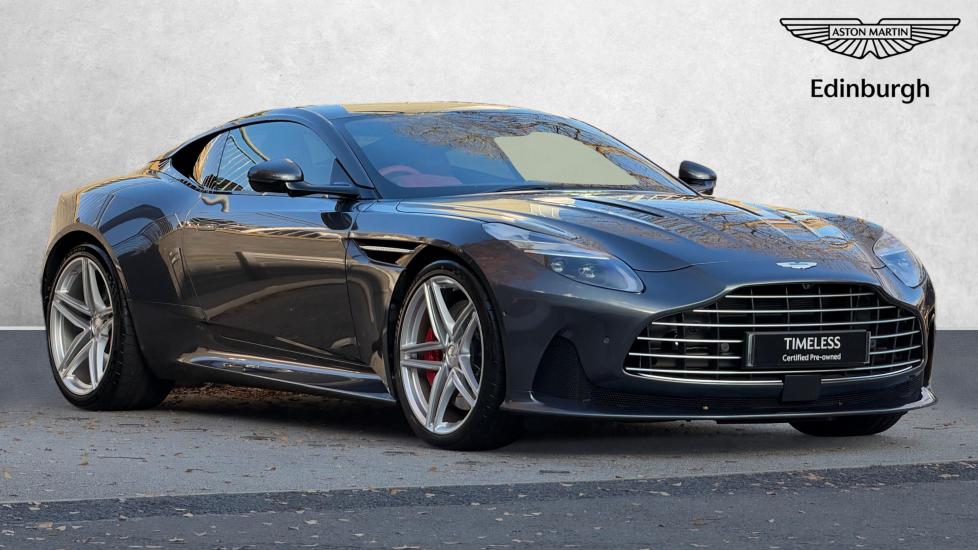
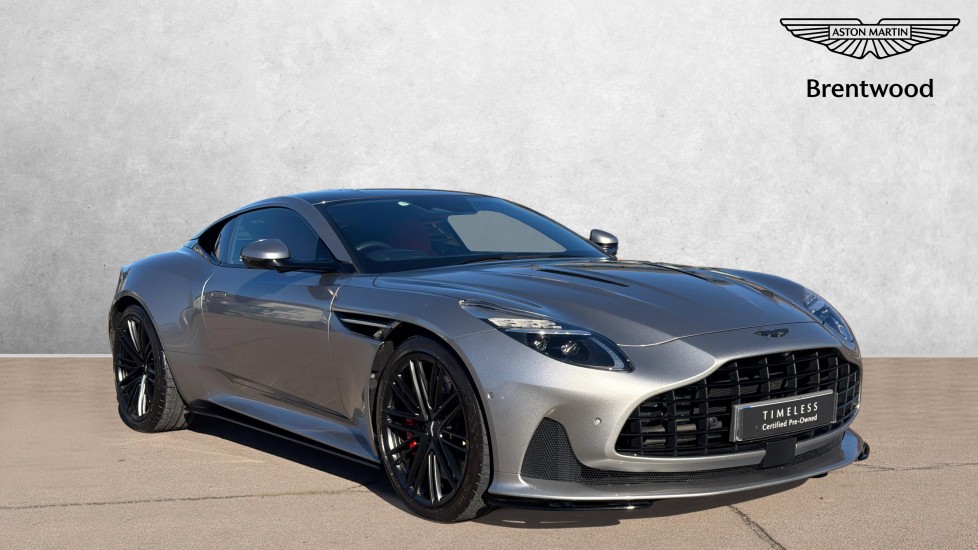
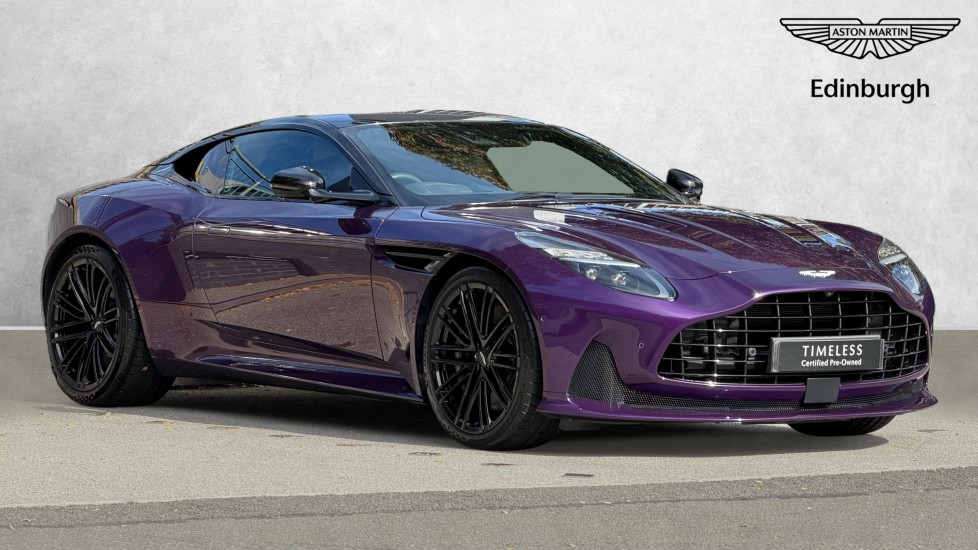
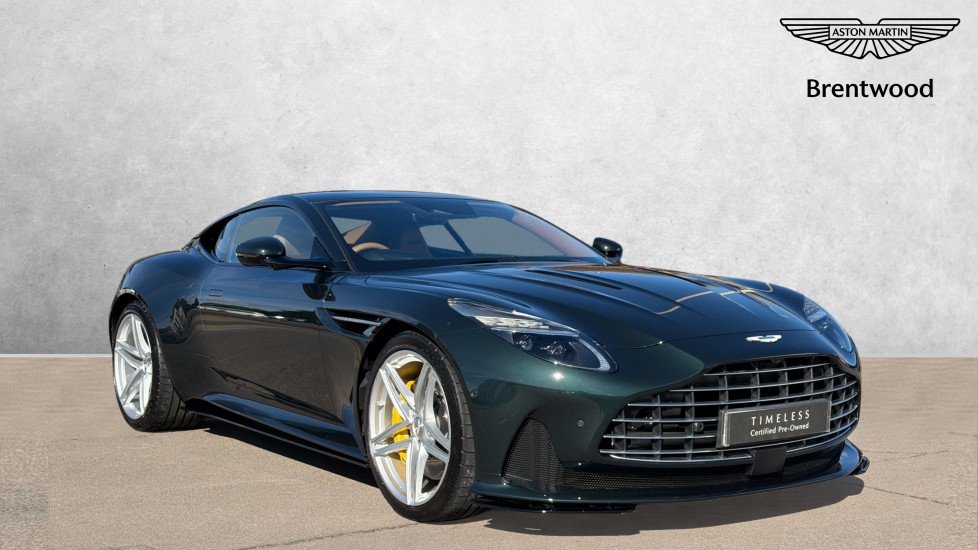
Compare the DB11’s slim lighting and sculpted flanks with DB12’s larger grille and more assertive front end. The engine is an important common thread: both cars here use a twin-turbo V8. The “12” in DB12’s name does not denote a V12 engine.[1][4]
DB11 V8

DB12

Engine: why the DB12 is more than a power increase
The original DB11 V8 produces 510 PS (503 bhp) and 675 Nm. Aston Martin used its own intake, exhaust, lubrication and calibration to give the AMG-supplied engine a distinct character. For 22MY, announced in July 2021, power rose to 535 PS. That is a meaningful distinction when you compare a later DB11 with an earlier one.[1][2]
DB12 develops 680 PS (671 bhp) and 800 Nm. Modified cam profiles, revised compression, larger turbochargers and greater cooling capacity support that output. Its extra performance is therefore backed by mechanical changes, rather than a software adjustment alone.[4]
Against the original 510 PS car, the increase is 170 PS; against the later 535 PS version, it is 145 PS. Those are different comparisons. DB11 already delivers substantial thrust; DB12 gives you more performance to explore, with the budget and restraint that implies.
Both use a rear-mounted eight-speed automatic, rather than a dual-clutch transmission. DB12’s 3.083:1 final drive is shorter than the DB11 V8’s 2.703:1. That increases the gearing’s mechanical multiplication at the driven wheels: the newer car’s urgency comes from gearing as well as the engine.[3][4]
| Specification | DB11 V8, original version | DB12, standard version |
|---|---|---|
| Engine | 4.0-litre twin-turbo V8 | 4.0-litre twin-turbo V8 |
| Power / torque | 510 PS / 675 Nm | 680 PS / 800 Nm |
| 0–62 mph | 4.0 seconds | 3.6 seconds |
| Maximum speed | 187 mph | 202 mph |
| Transmission / drive | 8-speed automatic / rear-wheel drive | 8-speed automatic / rear-wheel drive |
| Rear differential | Limited-slip differential | Electronically controlled E-Diff |
DB11 figures above apply to the original 510 PS Coupe, including the 2019 stock example featured here. The 22MY announcement specifies 535 PS and a 192 mph maximum. Acceleration figures use the same 0–62 mph test point; PS and bhp are different units.[1][2][3][5]

Steering and chassis: what changes at the contact points?
Both cars have electric power-assisted steering. DB12’s distinction is its non-isolated steering column and revised chassis calibration. The column gives the steering system a more direct mounting; it should not be confused with a switch from electric to hydraulic assistance.[3][5]
The DB11 V8 combines adaptive damping with a conventional limited-slip differential. DB12 adds an E-Diff integrated with the stability system. Its ability to vary locking rapidly gives the chassis another way to manage cornering response and traction. Aston Martin also increased the bonded aluminium structure’s torsional stiffness by 7% and introduced Bilstein DTX adaptive dampers.[3][4][5]
Wheel and brake specification matters here for a concrete reason. DB11 V8 launched on 20-inch wheels; DB12 uses 21-inch forged wheels. Standard DB12 brakes use iron discs, while optional carbon ceramics save a claimed 27 kg of unsprung mass. That is mass the suspension must control at the wheels, so the option has relevance beyond appearance.[3][5]
DB11 V8

DB12

On British roads: precision, comfort and honest expectations
Do not mistake DB11 V8 for simply a cheaper version of the original V12. In his March 2018 UK road test, Top Gear’s Ollie Marriage praised the V8’s clearer turn-in and more cohesive handling, while noting road noise and low-speed brake modulation as areas to assess. That finding relates to the V8 tested, rather than every DB11 derivative.[6]
Marriage’s February 2024 DB12 review describes a more accurate, better-supported chassis that retains long-distance cruising ability. That is the central reason to consider the newer car: more usable control of its performance, alongside the extra power.[7]
There is useful nuance in the road tests. Auto Express’s Steve Fowler enjoyed DB12’s steering and smooth eight-speed gearbox, but found rough-road comfort and tyre noise less convincing. In a separate April 2025 long-term report, Rowan Horncastle at Top Gear preferred an Individual setup that avoided maximum suspension stiffness on British surfaces. His test car also experienced electronic faults, so its praise should not be read as a reliability guarantee.[8][9]
Our conclusion from those tests is to treat DB12 as the stronger choice for a driver who values body control and cabin technology, while allowing the DB11 V8 to stand on its own appeal and price. A comparable route over broken tarmac, flowing bends and motorway joints is more revealing than selecting the firmest mode in either car.
What if you want the occasional circuit day?
DB12 offers the more compelling engineering starting point: the E-Diff, wider damping capability and optional carbon-ceramic brakes all serve the driver when demands increase. Its stability system includes a Track setting, separate from the main driving modes.[4][5]
These are GTs with considerable performance, and a road-test verdict does not establish sustained circuit pace. We have not conducted a back-to-back track test. For occasional circuit use, establish brake specification and condition, tyre suitability, cooling preparation and event requirements with the Aston Martin team. A Track setting does not itself confirm warranty or insurance cover; obtain the terms for your car and intended event before booking.
The cabin may be the upgrade you notice most often
DB11’s cockpit centres on a high-mounted 8-inch screen and a rotary controller with touchpad input. Its separate transmission buttons and leather-lined centre console have a character of their own. DB12’s new dashboard architecture moves to Aston Martin’s in-house 10.25-inch touchscreen system, supported by physical controls for frequently used functions.[3][10]
DB11 V8

DB12

For everyday use, the upgrade is about how you navigate, change settings and interact with the car. It also introduces a purchase-specific question: which software and connectivity does this particular DB12 have? Aston Martin debuted CarPlay Ultra in 2025; Grange’s current information makes availability subject to model and market. Do not assume that an early DB12’s launch specification describes its software today, or that every pre-owned example already has Ultra installed.[10][11]

Both Coupes retain occasional rear seats. Neither should be bought on an assumption of four-adult touring space. Front-seat choice deserves attention too: our DB11 example has heated and ventilated Comfort Seats, while the DB12 has a Light Duotone Inspire Comfort interior. Those are the specifications of the pictured stock cars, rather than promises about every DB11 or DB12.[12][13]
DB11 V8

DB12

UK prices: what does the step to DB12 buy?
The original DB11 V8 launched in June 2017 from £144,900 in the UK. DB12’s 2023 launch price was £185,000; PistonHeads’ March 2026 buying guide subsequently quoted £197,500 for a new 2026MY Coupe. These are dated new-car benchmarks, before the effect of individual options, rather than a fresh November 2026 factory quotation.[1][14]
For a purchase today, actual cars make the comparison more useful. On 20 November 2026, Grange advertised the following examples:
| Car | Advertised details | Cash asking price |
|---|---|---|
| 2019 DB11 V8 Coupe | 29,299 miles · Aston Martin Edinburgh · KX19KEM | £71,950 |
| 2025 DB12 Coupe | 9,320 miles · Aston Martin Brentwood · EA74YYF | £144,900 |
Illustrative vehicles, not market averages or a valuation of every DB11/DB12. Prices, mileage and availability can change. Open the current listings for the latest details.[12][13]
That is a £72,950 difference between these two advertised cars, reflecting age, mileage, specification and model generation together. It cannot be attributed entirely to DB12’s engineering. DB11 provides the lower-cost route to the V8 DB experience; DB12 asks a greater commitment for its added performance, chassis control and technology.
The DB12 listing specifies over £31,000 of options, including a carbon-fibre roof and carbon trim, plus the remainder of a five-year service plan. Those options are already fitted, not an instruction to add their original cost to the asking price. Ask Grange to confirm the remaining service entitlement and any transfer conditions. For a new car, request a current UK quotation for the exact DB12 derivative and specification you want.[13]
Timeless and factory warranty: two different routes to reassurance
The featured DB11 is explicitly advertised with 12 months of Aston Martin Timeless warranty and roadside assistance from collection. Grange’s Timeless information describes more than 140 inspection checks and a 12-month, unlimited-mileage warranty with roadside assistance.[12][15]
Aston Martin’s programme information covers eligible pre-owned cars up to ten years old and describes work by Aston Martin-trained technicians using genuine parts. It also identifies exclusions: paint, bodywork, soft trim, routine service items such as tyres and brakes, and normal wear. UK MOT test cover is described for eligible cars over two years old. Full policy terms govern the actual cover.[16]
The featured DB12 listing instead advertises manufacturer warranty until 2028. That is distinct from starting a fresh Timeless policy. Confirm its precise expiry date, remaining cover and the handover documentation, together with the separate service-plan entitlement. Neither a warranty nor a service plan makes all future running costs disappear.[13]
Which Aston Martin would we shortlist for you?
DB11 V8: the value-led GT choice
For someone drawn to the V8 soundtrack, classic cockpit and DB proportions, the featured DB11 leaves substantial budget available for ownership. Its own chassis development and 510 PS output make it more than an entry on a price ladder. Later 535 PS cars offer another specification to consider.
DB12: the broader dynamic upgrade
For someone who will appreciate stronger responses, more chassis control and contemporary infotainment on every journey, DB12 makes a specific engineering case. Those improvements are easier to justify when they match how you drive and use the cabin.
There is no need to dismiss one to explain the other. Start with the experience you want, then compare the real price gap between suitable cars. The newer Aston is more capable on paper; whether its advantages are worth the additional spend is a personal decision.
A long Aston Martin relationship, with support beyond the sale
Grange was founded in Brentwood in 1956. Its history records an Aston Martin dealership at Welwyn Garden City in 1985, later relocated to Hatfield. Today, Grange’s Aston Martin network includes Birmingham, Brentwood, Edinburgh and Hatfield. That gives this comparison a practical next step: access to the cars, their records and the teams who support them.[17][18][19]
Tell the team whether you are moving from a DB11, buying your first Aston Martin or choosing a car for long-distance travel. Ask for a demonstration of the specific differences covered here, along with the preparation, warranty and servicing position of the car you select.
DB11 V8 vs DB12: quick answers
Does DB12 have a V12 engine?
No. The standard DB12 compared here has a 4.0-litre twin-turbo V8. DB11 was available with V8 or V12 engines, so confirm the derivative when browsing.
Are all DB11 V8s 510 PS?
No. The original version produced 510 PS; the 22MY update announced in July 2021 increased this to 535 PS. The featured 2019 Coupe is the earlier 510 PS version.
Is this a DB12 S comparison?
No. DB12 S is a separate derivative. The figures, standard brake specification and review findings in this guide relate to the standard DB12 unless stated otherwise.
Does every used Aston Martin have the same warranty?
No. The featured DB11 advertises Timeless cover; the featured DB12 advertises remaining manufacturer cover. Obtain the exact policy and dates for your selected car before purchase.